Friday, 26 July 2013

What do Muslims do to help Syrians?

Muslims only know how to lie about America and the West.

U.S. uses Syrian rebel supply lines as it prepares to send arms

Related Topics

A Free Syrian Army fighter fires back towards what he said were forces loyal to Syria's President Bashar Al-Assad in Deir al-Zor July 22, 2013. REUTERS/Khalil Ashawi
WASHINGTON | Thu Jul 25, 2013 6:33pm EDT
(Reuters) - The United States has quietly been testing the Syrian opposition's ability to deliver food rations, medical kits and money to rebel-held areas as Washington prepares to send arms to the rebel fighters.
U.S. officials meet weekly in Turkey with Syrian opposition leaders to work out how best to keep supply lines open to rebel fighters and war-ravaged towns and districts.
One of the Syrian opposition's best-known female leaders, Suhair al-Atassi, attends the meetings as coordinator of the "non-lethal" aid that includes equipment for rebel fighters and local councils, as opposed to humanitarian aid for the displaced.
Supplies are handed to officers of the moderate Free Syrian Army (FSA) at clandestine locations that cannot be divulged for security reasons.
"I sign the paperwork, and shake the hands of the FSA official," said a U.S. State Department official involved in the effort. "I wish them well and walk away."
The rebels take aid for their own units and also distribute some of it to schools, clinics and local councils.
The United States has committed $250 million in non-lethal aid to Syria in addition to the $815 million in humanitarian assistance in support of the rebels fighting President Bashar al-Assad's forces.
Recently, Washington began scaling up its assistance to bigger items like trucks, radios, large generators and sophisticated medical equipment.
Some of it is not only aimed at helping fighters but also at supporting civilian authorities in towns that have rejected Assad's rule.
"We are just now starting to send large equipment over the border for local councils and cities in liberated areas," the U.S. official said.
Syria's civil war has killed more than 100,000 people and forced millions to flee their homes. The involvement of Iran and its Lebanese ally Hezbollah in the conflict has shifted the balance of power on the battlefield in favor of Assad, increasing frustration among rebels over delays in the United States sending weapons to them.
With no U.S. diplomatic presence on the ground, Syria presents a unique challenge for aid coordinators.
U.S. officials say they rely on a network of some 75 young Syrians who collect information in rebel-held areas and report back to Atassi's unit. The information is often corroborated with U.N. groups.
SUPPLYING WEAPONS
The U.S. Congress cleared the way earlier this month for Washington to give the rebels not just non-lethal and humanitarian aid but also weapons. Lawmakers have only approved limited funding for the arms operation, as they fear that U.S. weapons and ammunition could end up in the hands of hardline Islamist militant groups.
"One of our main issues is to make sure that, whatever we do, that nothing gets in the hands of al Qaeda," said Dutch Ruppersberger, the top Democrat on the House of Representatives Intelligence Committee.
To keep track of the non-lethal aid already going into Syria, American officials ask the opposition to bring back photographic evidence of deliveries as proof that the goods made it into the right hands.
"If we are providing small amounts of cash to a local council to pay salaries we insist on signatures and photographs," said the official. "One of the ways to minimize the risk is we keep the amounts of cash small and would pay something like a stipend rather than a salary."
While it is not always easy to guarantee that supplies reach their intended recipients or that they don't eventually make their way to the black market, the Syrian opposition coordinators have begun to earn the trust of U.S. officials.
"They have so far passed the test," the official said.
France also sends supplies to the rebels, including envelopes stuffed with money handed over at the Turkish border.
(Reporting by Lesley Wroughton; Additional reporting by Patricia Zengerle; Editing by Alistair Bell and Eric Beech)

 http://www.reuters.com/article/2013/07/25/us-syria-crisis-usa-idUSBRE96O1H020130725

Tuesday, 23 July 2013

The price of US involvement in Syria

http://www.usatoday.com/story/news/politics/2013/07/22/dempsey-letter-to-mccain-and-levin-on-syria/2576481/

Dempsey gives details on U.S. options in Syria

SHARE 33 COMMENTMORE
WASHINGTON – The Pentagon has prepared military options for responding to the Syrian crisis ranging from bombing targets inside the country to deploying thousands of ground forces to secure chemical weapons sites, the chairman of the Joint Chiefs of Staff said in a letter to the chairman of the Senate Armed Services Committee.
Gen. Martin Dempsey made clear that he was just presenting options and the decision is for civilian leaders to make.
Dempsey's letter to Sen. Carl Levin, chairman of the Senate Armed Services Committee, is the most comprehensive public description yet of the stark choices the administration faces in responding to a civil war that has lasted more than two years, has led to the deaths of 100,000 and has confounded U.S. policymakers.
Dempsey provided the options in response to a request from Levin and Sen. John McCain of Arizona, a ranking Republican member of the committee, which is considering his nomination for a second term as chairman.
Dempsey came under fire last week from McCain, who sharply questioned Dempsey during his confirmation hearing. Dempsey had been reluctant to publicly discuss options while the White House is still reviewing them. McCain has advocated for a stronger response to the civil war in Syria.
The White House has been reluctant to get too deeply involved in the conflict. The U.S. government is providing non-lethal aid to rebels and recently the White House said it would begin providing arms and other support for rebels.
The options outlined by Dempsey would involve a much deeper involvement by U.S. forces, carrying with them high costs and significant risks.
The options outlined by Dempsey include:
• Train, advise and assist the opposition. Ground troops would be used to train rebels in tactics and the employment of weapons. The number of troops required ranges from several hundred to thousands. It would require establishing safe zones outside Syria and would cost an estimated $500 million a year initially.
The plan risks inadvertently helping extremist groups who are among the rebel groups fighting the regime of Bashar Assad, Dempsey said. It could also provoke cross border raids by Syrian government forces and could result in insider attacks against U.S. forces.
• Stand-off strikes. Aircraft and missiles would be used to attack hundreds of Syrian government military targets, such as air defense systems and regime air and naval forces.
This option would require the United States and its allies to muster "hundreds of aircraft, ships, submarines, and other enablers," Dempsey wrote. It risks provoking retaliatory strikes by the Assad regime and could also result in inadvertent civilian casualties, he said.
• No-fly zone. This option would be designed to ground Assad's aircraft, preventing them from attacking civilians and rebels. It would also stop Assad from supplying his forces by air. This option would require knocking out the Syrian air defenses and attacking Syrian aircraft on the ground and in the air. It could cost as much as $1 billion a month for a year.
This option could result in the loss of U.S. aircraft, he said. It may also fail to reduce violence or shift the balance of power on the ground, since Assad's forces rely heavily on mortars and artillery -- not only aircraft -- to attack rebels.
• Buffer zones. This option calls for the establishment of sanctuaries for rebel forces outside Syria, most likely in neighboring Turkey or Jordan. The zones would allow rebels to train and humanitarian aid could be distributed to refugees.
"Thousands of U.S. ground forces would be needed, even if positioned outside Syria, to support those physically defending the zones," Dempsey wrote. It would also require a limited no-fly zone to prevent attack from Assad's aircraft. The cost would exceed $1 billion a month.
The risks include Assad's forces firing artillery into the zones and killing refugees. "The zones could also become operational bases for extremists," Dempsey wrote.
• Control chemical weapons. This plan calls for destroying portions of Syria's stockpile of chemical weapons, interdicting their shipment around the country and seizing and securing weapons components. It would require establishing a no-fly zone and launching air and missile strikes "involving hundreds of aircraft, ships, submarines and other enablers," Dempsey said. "Thousands of special operation forces and other ground forces would be needed to assault and secure critical sites."
The costs could exceed $1 billion a month, he said.
"Once we take action, we should be prepared for what comes next," Dempsey wrote.

Monday, 22 July 2013

Excuses for not knowing what to do

http://www.guardian.co.uk/technology/2013/jul/21/microsoft-realignment-steve-ballmer-naughton

How Microsoft spent a decade asleep on the job

Internet search, online advertising and smartphones all caught Microsoft napping, but is the behemoth finally stirring?
Microsoft owner and founder Bill Gates
Microsoft owner and founder Bill Gates poses with Microsoft's first laptop in 1986. Photograph: Joe Mcnally/Getty Images
Once upon a time, a young man named Bill had a vision. He saw "a PC on every desk, and every machine running Microsoft software". And lo, it came to pass, and the company Bill co-founded became a gigantic machine for making money, and Bill became the richest man on Earth.
This agreeable outcome was arranged in a most ingenious way. The tedious business of making computer hardware was left to others – so-called "original equipment manufacturers" (OEMs), who sweated away in Taiwanese and other jungles manufacturing machines that attracted ever-smaller profit margins. All Microsoft did was to write the software for the operating system and the Office applications that transformed OEM hardware from expensive paperweights into something that could do useful corporate work.
Because most of the expense in creating software is incurred upfront, once it's been written every subsequent copy is, effectively, free to produce. And because for a long time Microsoft Windows was the only game in the corporate town, all Bill and his mates had to do was collect their monopoly rents. Which they did.
Indeed, they were so focused on the revenue stream that flowed from the world's desktops into their coffers that they failed to notice an important development. It was called the internet and a cheeky start-up company called Netscape was busy exploiting it.
Netscape's leaders even talked boldly about the likelihood that a program called a "web browser" might one day replace operating systems like Windows.
Now that did get Bill's attention, and in 1995 he composed a famous internal memo that likened the net to a tidal wave. "Developments on the internet over the next several years," he wrote, "will set the course of our industry for a long time to come… I have gone through several stages of increasing my views of its importance. Now I assign the internet the highest level of importance. In this memo I want to make clear that our focus on the internet is crucial to every part of our business. The internet is the most important single development to come along since the IBM PC was introduced in 1981."
The internet threat was so grave, in Gates's opinion, that every part of Microsoft's operation – and every one of its products – should become network-focused. And the astonishing thing is that he managed to make that happen. In a remarkable example of corporate leadership, he turned the company on a dime. In the process, he almost ensured that Microsoft was broken up because of its determination to destroy Netscape. A federal judge found that Microsoft had abused its monopoly position by incorporating its (inferior) web browser into its operating system. Ultimately, Microsoft appealed and the resulting anti-trust suit was knocked somewhat off course amid George W Bush's election victory in 2000, and the company survived to breathe again.
Coincidentally, in that same year, Gates stepped down from his position as CEO and began the slow process of disengaging from the company. What he failed to notice was that the folks he left in charge, chief among them one Steve Ballmer, were prone to sleeping at the wheel.
How else can one explain the way they failed to notice the importance of (successively) internet search, online advertising, smartphones and tablets until the threat was upon them? Or were they just lulled into somnolence by the sound of the till ringing up continuing sales from the old staples of Windows and Office?
But suddenly, that soothing tinkle has become less comforting. PC sales are starting to decline sharply , which means that Microsoft's comfort zone is likewise set to shrink. Last week, we had the first indication that Ballmer & Co have woken up. In a 2,700-word internal memo rich in management-speak drivel , Ballmer announced a "far-reaching realignment of the company that will enable us to innovate with greater speed, efficiency and capability in a fast-changing world".
The various internal warring silos known as "product groups" will be disbanded and the entire company (97,000 employees) is to be rejigged on "functional" lines (engineering, marketing, advanced strategy and research), with the aim of "focusing the whole company on a single strategy".
And what, pray, is this vision, this single strategy upon which all are to agree? Why, "to execute even better on our strategy to deliver a family of devices and services that best empower people for the activities they value most and the enterprise extensions and services that are most valuable to business." Which, translated, reads: we haven't a clue, really, but we need to be seen to be doing something.
Say what you like about Bill Gates, but you have to admire his timing: he got out when the going was still good.

Wednesday, 10 July 2013

You can make money from the Police illegal arrests


Lawyers, activist win suit against govt over arrest

KUALA LUMPUR, July 10 (Bernama) -- Five human rights lawyers and an activist today won their suit against the police and the Government over their arrest, detention and malicious prosecution during a walk to mark World Human Rights Day on Dec 9, 2007.
The court awarded R. Sivarasa, N. Surendran, Latheefa Beebi Koya, Eric Paulsen, Amer Hamzah Arshad and activist Johny Andu @ Abu Bakar Adnan each with RM10,000 in damages, and ordered the defendants to pay a total of RM60,000 in costs to all the plaintiffs.
On Dec 8, 2010, they filed a civil suit against then-Dang Wangi police deputy chief Superintendent Che Hamzah Che Ismail, inspector-general of police, home ministry and the government over their arrest, detention and prosecution.
In allowing their claim, High Court judge Datuk John Louis O'hara held that their arrests and detention by the defendants were unlawful.
O'hara said he had the opportunity to view the video and photographs taken from what transpired and took place during the incident.

 http://mysinchew.com/node/88603?tid=4

Excellent Economic analysis of Malaysia in July, 2013

 http://www.malaysia-chronicle.com/index.php?option=com_k2&view=item&id=126412:malaysias-credit-squeeze-property--share-prices-sure-to-fall?&Itemid=2#axzz2YawrSoWa

EDITOR'S PICK Malaysia’s current household debt problem is not the result of our government’s recent policies to encourage private expenditure. Actually, the current debt problem has been accumulating for the past 15 years. The history of Malaysia’s household debt can be traced back to 1997 when the household debt to GDP was only 39% then. This was also the year that Malaysia was struck by the Asian Financial crisis.
Since then, Malaysia embarked on an expansionary fiscal and monetary policy which led to an expansion of credit and also the proliferation public projects so as to extract its economy out of the recession. During the Asian Financial Crisis in 1999 Malaysia’s GDP per capita felled to $3653.83 compared to $4043.64 recorded in 1998. However since then as the expansionary policies worked its way into the economy, Malaysia’s GDP per capita risen as a result. This can be shown by the following graph on Malaysia’s GDP per capita since 1995.
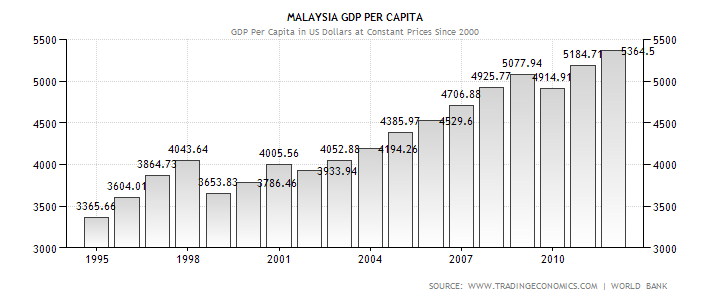
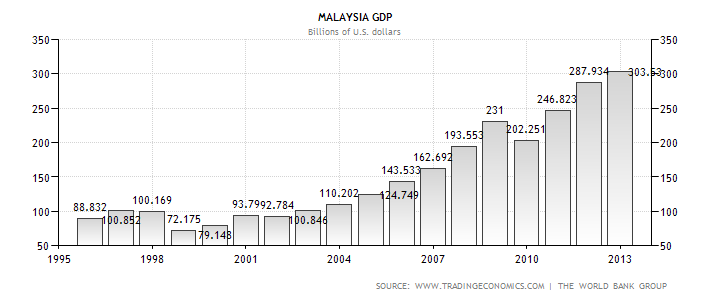
To encourage the private sector to spend, lending procedures are relaxed and interest rates are held low. As a result of the increases in both private and public expenditure, Malaysia’s GDP recorded a fourfold increase in 2012. In 1999, Malaysia’s GDP was valued at $72.175 billion and has since risen to $303.53 in 2012. This can be shown by the following chart.
However, the credit expansion brought about by our government earlier has led to a further increase in the household debt. As of 2010 Malaysia’s household to GDP debt has reached 78% where more than 55% of the loan concentration is in the mortgage market and 23% into the automotive market. And in 2012 the ratio went up to 83% which represents an increase of 13% from 2011.
Our next question is what contributed to our record Household Debt?
False Expectation of improved economic conditions brought about by our Government. We have mentioned many times in our previous articles that our Government has been painting a false picture on the real condition of our economy. With the aid of the media we are led to believed that our economy is growing at a healthy pace (GDP growth of 4.1%), our stock market is resilient, our housing market is healthy and sustainable (no bubble yet) due to the increasing rural to urban migration of the workforce and so on.
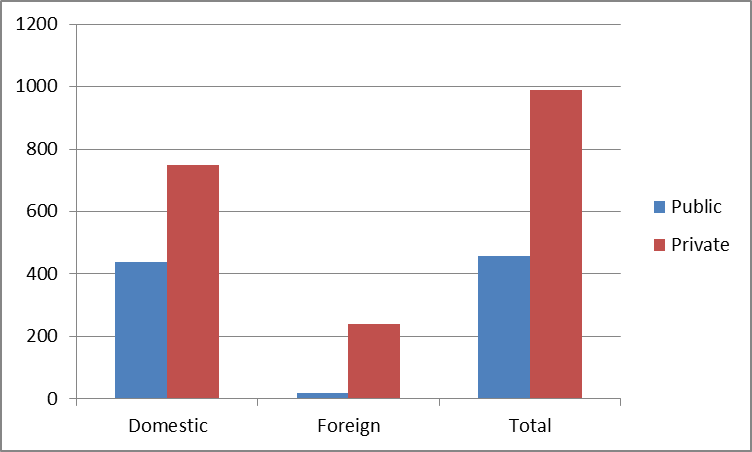
The easy availability of credit in the past and the lack of supervisory on the part of Bank Negara had led to an enormous build-up of the private sector debt. We shall present again the following chart which we have already mentioned in our last article titled ‘Is our GDP growth a Hoax?’
The following is the chart for the total debts by the private and Government sector as of 2011.
Debt
Domestic
Foreign
Total
Public
438
18
456
Private
749
239
988
Given the GDP of RM 860 billion we can then proceed to calculate the Debt/GDP ratio of both the public and private sector. The table below summarizes the ratio of domestic and foreign debts held by the public and private sector.
Debt
Domestic
Foreign
Total
Public
51%
2%
53%
Private
87%
28%
115%


From the above we can conclude that at the present moment the private sector poses a greater risk to financial default than the public sector. This is due to the fact that the private sector is much more exposed to any downside risk, arising not only from size of the debt (87%) but also its exposure to foreign debt (28%). Large exposure to foreign debt is risky because it is subjected to movements in foreign currency (US$ in this case) or external systemic market risk.
The movement of the US dollar creates currency risk or what we called ‘Foreign Exchange Exposure’ in Treasury terms. Foreign Exchange Exposure refers to the risk associated to a decline in a country’s currency. Currency depreciation can have the effect of reducing a company’s profits due to increased cost in imports or loss due to the higher repayments of loans denominated in US dollar.
How big a loss associated with currency movement depends on our Ringgit. On the negative node our country is currently running a ‘Twin Deficits’. Twin Deficits refers to a situation when we are having two economic problems at the same time (Budget Deficit + Balance of Trade Deficit). Twin deficits are known to create havoc in an economy by accelerating the decline of a country’s currency and in this case the Ringgit. So, obviously the risk of default in our private sector has certainly increased due to the problems coming in from multiple fronts.
A boom in the Housing and Stock Market. The boom in the housing and stock market for the past couple of years has increase the risk appetite of investors. Somehow they reckoned they have found a way to make money without putting much work. To them making money can be as easy as sitting in the stock market and pressing some buttons or flipping some real estates. Hence this led to many of them holding to a portfolio of 3 to 4 houses which risked being wipe-out should there be a serious downturn in the real estate market.
A strong response from the private sector especially from the business community to increase their exposure to debt due to the expectation of better times ahead.
Problem with ARMs Mortgage
Another problem we are facing is that about 80% of the loans given to the housing market are in the ARMs (Adjustable Rate Mortgages) category which is also known as ‘teaser loan’ in the U.S. To lure prospective borrowers, banks offered very low initial repayments (such as BLR – 2 to 4%) during the first 3-5 years. Once that duration expires or resets then borrowers will have to start paying higher mortgages. That’s where the nightmare comes in.
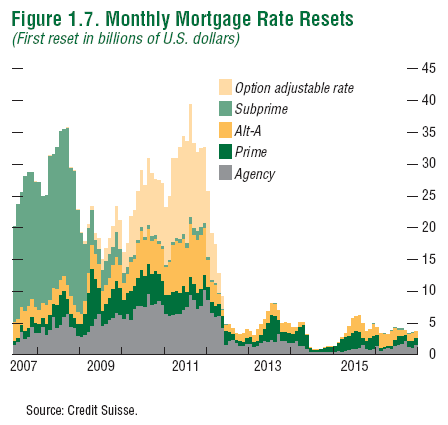
For example, a RM 200,000 loan with tenure of 20 years, the initial repayment can be as low as RM 800 a month. When the 3-5 years period expires, the loan will be automatically resets to higher interest rates, probably (BLR + 0%) and repayment will be more than RM 1000 per month. One thing to remember is that ARMs is one of the major contributors to the U.S Housing meltdown. The following is the U.S Monthly Mortgage Rate Resets.
As can be seen above, the U.S housing crisis is yet to be over as the mortgage resets will continue beyond the year 2015. As for Malaysia our total housing loans has risen to MYR 222.2 billion from about MYR 25 billion in 1996.
Below is the chart for the housing loans to GDP as from 1996 to 2011.
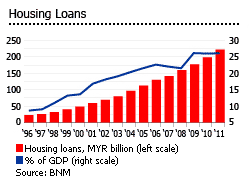
It shows that the outstanding housing loans has been on the rise since 1996 and reached MYR 222.2 billion in 2011 or around 26.1% of GDP, up 11.8% from a year earlier.
An oversupply of Housing?
According to C.H. Williams Talhar & Wong, there is an oversupply of high-end condominiums in Malaysia especially in Kuala Lumpur, Johor Bahru, Kota Kinabalu, Kuching and Penang. The following chart shows the relationship between the housing approval and oversupply.
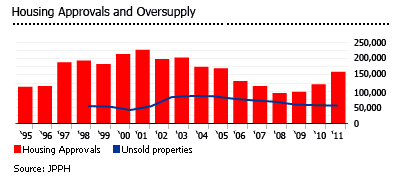
The over-supply of high-end condominiums remains a concern while a further 2,300 units of high-end condominiums will be completed in 2012, half located in the Kuala Lumpur City Centre (KLCC).
In total, around 54,557 properties were unsold at end-2011, down 2.3% on the previous year, and down 34.9% from the 2004 peak of 83,811 units. There was a 62.3% decline in house launches during the year to Q4 2011. It clearly shows that the housing market is already softening since the end of 2011. Moreover, we also received reports from real estate agents complaining that high-end properties (over MYR 1 million) are very sticky or difficult to sell.
Bank Negara Malaysia’s new measures
We are certainly living in interesting times. Fundamentally, our economy is weak. Our exports are plunging, our trade balances and deficits are negative and the only things that are going up are our companies bankruptcy that is on record territory, stock market, consumer spending, inflation, private and public debts. It seems like things are moving in opposite directions. Positive economic indicators are moving down while negative economic indicators such as inflation and household debts are moving up.
In view of our credit expansion problems, Bank Negara Malaysia (Central Bank of Malaysia) is implementing the following measures to curb the excessive debt incurred on the private sector namely the Household and Housing sector with immediate effect (06/07/2013).
> Reducing tenure of housing loans from 45 to 35 years
> Limiting tenure of personal loans to the maximum of 10 years.
> Prohibition of offering pre-approved personal financing products.
Before we address the effects of the above measures, we would like to digest what Bank Negara hoped to achieve with the above measures. In short, Bank Negara is trying to reduce the banking sector’s exposure to real estate and personal loans. In trying to do so, it is employing a strategy known as ‘shortening of maturities’. This can be literally translated in plain English as ‘the government is more concerned with short term instability than promoting long term growth’. In part, these measures we believe are also directed towards resolving our big budget deficits and Government Debt to GDP problem. Again these problems are due to our excesses in the past few years of credit expansion.
So how will the Government going to fix this problem? Our Government hoped that by reducing the credit, it will help reduce domestic consumption on consumer goods and real estate and at the same time try to expand the exports. This in time will helped reduce the trade balance due to the increase in exports and decrease in imports. By this our Government hoped to help built a sounder economy with a better income foundation and lesser debts.
However along the way a lot of people are going to get hurt due to the credit squeeze but there is no other choice if we want a transition to a better and more sustainable economy. Hopefully, more resources will be directed towards the more efficient part of the economy such as building more plants, better infrastructure, modernising production facilities or anything that can help the economy to make real products which can be used for domestic consumption or exports which will in turn earn foreign exchange. Our next question is will it work?
Will it work?
It appears that Bank Negara is definitely worried on the banking sector’s exposure to real estate. Any big downturn in real estate prices will definitely have profound effects on the economy. Among them are unemployment resulted from the construction related business and also the growth of NPLs in the banking sector. Below are the problems that may arise as a result of the latest measures.
Limitations to Monetary Policy – Long Lag
Central Banks have always been prudent in their approach towards the economy and that is the main problem. Sometime they waited too long before they act or when the problem is evidently long in its tooth. The slow response may be due to the problems associated with monetary policy implementation and they are the long-lag response and genie out of the bottle response. Monetary policy such as increasing the interest rate to counter inflationary pressure might take 6-9 months to work its way into the economy. If they waited until the inflationary effect is visible to us then it is already too late because the inflationary effect has already accelerated too much and the interest rate increase will have not much effect in contracting the economy.
Similarly to what is happening in Malaysia. Bank Negara should have taken action many months ago to stem the borrowing to the private sector and not waited until the problem becomes obvious. Now when they starting to take action, the genie is already out of the bottle and it is all but one hell of a difficult task to stuff the genie back into the bottle. The above measures will only have effects on new loans, how about the old ones?
Problem with our Shadow Banking System
This I would like to point out that as in many other countries we also have two different banking systems. One is called the formal banking where their operations are regulated by Bank Negara and the other one is the informal banking which is unregulated by Bank Negara. The informal banking system or Shadow Banking System consists of lending from private money lender and credit companies, inter-company loans, corporate bonds and loans by investment companies
Due to the current credit squeeze those who are unable to qualify for loans in the formal banks will turn to the informal banks. There are already a lot of evidence of individuals and SMEs and even developers are getting loans from the informal banks where maturities are short and interest rates are high. The problem is we do not know how large our informal banks are and what type of portfolios they are holding. Another problem is we do not know what sort of linkage or relationship between the formal and informal banks. If they are linked and if our real estate market were to collapse then the resulted decline in real estate prices will be serious, due to the following.
There will be force sales of real estate financed by the informal banks. This self-reinforce selling will further depress the prices of real estate. This is the last thing our Government wants because when the informal banks start to liquidate their assets to raise cash then it will cause further downward pressure on the market.
Informal banks may have got their funding from the formal banks. So any credit squeeze will certainly have effect on the operations of the informal banks which might force them to shorten the maturities, recall or totally freeze their loan operations.
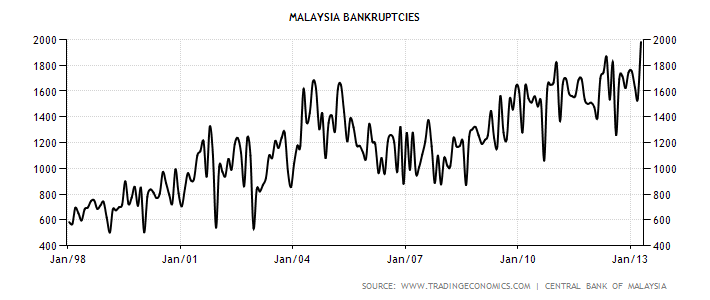
Without funds to finance their operations, many businesses may have to cease their operations. With the expected softening of the real estate market developers who have been snapping up land to build up their land banks will find it difficult to stay afloat. This can be shown with the following chart on bankruptcies in Malaysia from April 2011 to May 2013.
As from the two charts above, Malaysia recorded an increase in company bankruptcy. Total company bankruptcies reached a high of 1981 companies in April 2013. This is the highest ever number of bankruptcies recorded since January 1998. In view of the credit crunch we expect to see much more bankruptcies in the month ahead.
Hence, such risk is real and is already happening. Credit squeeze means there will be lack of funds available to individuals and companies and hence liquidity. Since liquidity is the lifeline of both the housing and stock market, a lack of it will definitely have profound effects on them. Lacked of liquidity will cause seizing up of transactions because of the negative expectations on the economy will make people and businesses lee willing to spend, which eventually will drive prices down. Even before the implementation of the credit squeeze the housing market has already shown signs of weakness.
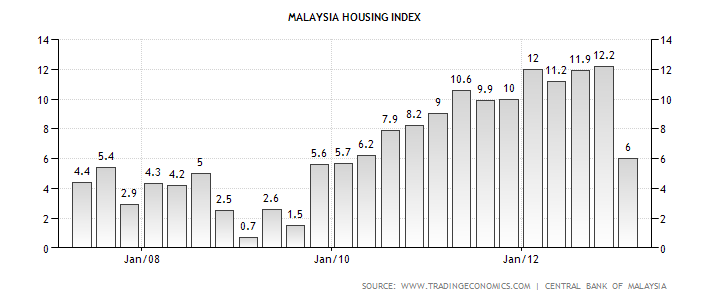
The Housing index refers to the residential construction activity during a period of time. As indicated by the housing index below, our residential construction activity has declined to 6% in the first quarter of 2013 from 12.2% recorded in the last quarter of 2012. It represents more than a 50% drop on a quarter to quarter basis. At 6% it brings us back to the level recorded in the early 2010 when our economy is just started to recover from the Global Financial Crisis in 2008. This big drop in housing activity certainly worries the authorities and which might be attributed to the over-leveraged consumers and also the peaking of the housing prices.
Housing prices in Tier-1 cities in Malaysia namely Kuala Lumpur, Penang and Johor Bahru has seen an unprecedented rise due to the easy availability of credit that resulted in a speculative frenzy. Any investment that is buoyed by easy credit especially housing and the stock market will eventually end up in a bubble. Despite numerous denials by our authorities the housing market in Malaysia has long been in a bubble.
As for the Stock Market we are saying it again. Sell and walk away. From the chart the market has been on the Distribution phase since 05/05/2013. We have drawn two lines that represent the distribution area and we will expect the market to breakdown from the lower line in the coming weeks. By then you will see an extremely volatile market.

Due to the credit contraction we are expecting a continuation of decline into the next few months. Any rebound will be another bear trap and we are seeing a much lower index in the next few weeks and month. In short we are BEARISH!
Malaysia Chronicle

Wednesday, 15 May 2013

How to know when to leave a company.

Go to Menu
The Wall Says
It's Time To Go

By Nick Corcodilos

That Ache Is Your Career Telling You Something
Unfortunately, the act of changing jobs is usually reactionary rather than planned. Most of us are so busy doing our jobs that we simply don't have time to contemplate, much less pursue, a new job with another employer. When we do make a change, it's often because some immediate event forced change upon us. These kinds of events include, but are certainly not limited to, a downsizing, a disagreement with a boss, an unexpected job offer or a failure to get an expected raise.
Until one of these events occurs, we tend to grin and bear surprisingly high levels of discomfort about our careers, our jobs and our future. Consequently, we rarely stop to recognize legitimate "change signals" or to ask the question, "Is it time for me to go?"
If you're experiencing career discomfort, I want to poke you where it hurts so it'll hurt a little more — not to antagonize you, but to encourage you to figure out exactly what's causing it. If you can do that, you might be able to start planning your next career step, before circumstances step on your career.
Have a cup o' Joe
with The Headhunter
Wish you could have a cup of coffee once a week with The Headhunter -- for help in getting an edge on your career?
Want more great tips about job hunting, interviewing, and hiring?
Sign up now for the free weekly Ask The Headhunter Newsletter, delivered via e-mail.
Can't figure out why your resume languishes while your competitors get job offers? Click for the answer. (Coffee not included.)
 
The Writing On The Wall
You probably know what I'm talking about. You see the writing on the wall, but like most busy people, you ignore it so you can get on with the daily chore of slaying another dragon at work. But it's time to start reading the signals your career is sending you. If you decide these signals are not so serious and your discomfort is more imagined than real, maybe you'll relax a little and enjoy your job more. If you're in considerable pain, maybe I can help you isolate the specific signal that's tormenting you. Then you can make some specific decisions and take control of your work life.
People tend to go on interviews for the same reason a mountain climber climbs a mountain: because "it's there." Headhunters deal with that by having more than one candidate available for the client. But they also devote considerable effort to helping the candidate isolate the reasons that led him to consider a change. That's how the headhunter develops his "pitch" to sell the position to the candidate. (I don't use that word pejoratively; a pitch can be very honest and sincere.) That is, we play the role of "the shrink," trying to make a connection between the new job and a person's needs and discomforts. Unless we can get into the person's head and figure out what's really bothering him about his job or career, we can't motivate him to consider a new job seriously. It's part of our job to know what the writing on the wall might be, even before we meet the prospective candidate.
Let's look at some examples of the most common writing on the wall. It's up to you to decide whether it represents a compelling reason to consider changing jobs or employers.
The Wall Says: You're the top dog.
You know you're at the top of your game when everyone — including people outside your own department and from other companies — comes to you for help and advice. In itself, this realization might make you want to keep your job rather than leave it, especially if your company recognizes your expertise and supports and rewards you for it.
On the other hand, if your boss treats you like a proprietary asset and restricts your movement in your professional community, it could be a sign that he doesn't know how (or want) to develop you further. Are you allowed to attend professional conferences and mingle with your industry cohorts? Does the company pay for relevant continuing education, or does it discourage you from developing skills beyond your current job?
Likewise, if you feel unappreciated and lonely and you sense that you're held too responsible for the success of projects around you, that's a bad sign.
Like it or not, being needed doesn't make you grow. Living on the pedestal can make you complacent, and it can also make you very bored. If your efforts to expand your expertise and to learn from greater experts meet with resistance, it may be time to go. (If you're not making such efforts on your own, shame on you. You may soon take a tumble.)
The Wall Says: You're on your own.
Every good worker needs a good mentor to guide, promote and pay attention to him. Good people don't keep working for employers who ignore them.
I remember watching a film about Japanese management practices back in the late 1970s. It showed a team of employees toiling away in a bullpen-type office, where there were no walls, no cubicles. Everyone worked out in the open. The only closed office belonged to the manager, and it was surrounded by glass. While his staff worked away, he sat with his feet resting on his desk reading the newspaper. The only time he got up was when an employee came in to ask for help. Then the manager dropped his paper and embraced whatever problem the employee was grappling with.
The narrator pointed out that employees rarely requested help with their actual work. Mostly they needed advice and guidance with larger problems, including career direction and personal challenges. One fellow needed advice about whether to ask a woman to marry him, for example. The thrust of the film was that a manager's job is to be a mentor, and although the manager spends most of the day with his feet up, his role is more important than any work being done in the office. His job is to enable his employees to take whatever steps are necessary to ensure their continuing value to the company.
If there isn't someone in your company who is helping guide your career and professional development, it may be time to go.
The Wall Says: You're ahead of your employer.
Just like product lines and technologies, skills and careers ebb and flow. Sometimes you find yourself thinking ahead of your company, and that can be frustrating. Bear in mind that it takes a corporate body longer to grow and change than it takes an individual. When you're evaluating your company's progress in the industry, what's important is not whether it is always on the cutting edge, but whether the company encourages or squelches the ideas of its more progressive employees.
Good companies have different ways of incubating change; make sure you understand how your company does it. It may be frustrating to have your ideas welcomed but not immediately acted upon. However, what really matters is whether the company embraces new ideas that contribute to its success.
If you believe your company's failure to implement your ideas is a signal to seek greener pastures, stop and ask yourself whether you're presenting your ideas effectively, and whether they're sound, profitable ideas for the company as a whole. It may be that you need to sharpen your own ability to judge the overall value of new concepts.
If, however, you find that you're always ahead of the company and no one is listening to you, it may be time to go. Remember that in a fast-paced business world we measure time not in months or years, but in product cycles. If more than two product cycles go by and your company's position in the industry keeps slipping and your efforts to prod it are ignored, don't make the mistake of thinking things will change any time soon. Act.
The Wall Says: There are too many walls.
If business has learned one thing in the last 10 years, it's that Henri Fayol's notion that every manufacturing enterprise must be broken into clear and distinct functions doesn't work very well. Keeping engineering, manufacturing, sales, finance, human resources and administration functions separated except at the highest executive levels is dumb. Cross-pollination of perspectives, ideas and skills enables a business to profit from what is today known as "our greatest asset — our people."
Your greatest growth potential will be realized through exposure to many disciplines within your company. I can't tell you how many times I've seen profound problems resolved quickly and simply when workers in disparate departments were allowed to put their heads together to find ways to do the work together. There is no MBA program that will "grow you" like the experience of working with people with skills different from yours.
If your contact with other departments or functions in your company is limited and you feel stuck in a corner, it may be time to go.
The Wall Says: Stay just the way you are.
This signal is painfully simple. If you haven't had the opportunity to learn or do something new in six months or more, it may be time to go. There are two main types of fallout from this situation. The first is obvious: without new skills and experiences, your value will not grow. The second is downright sad: your company will turn into a collection of overly specialized workers whose main concern will be their jobs rather than the company's business.
The Wall Says: Only the rich get richer.
I frequently get e-mail from people thanking me for my exhortations to seek a level of compensation that reflects their contribution to their employer's profitability. Of course, this "profit connection" is not easy to calculate or to communicate. It takes a lot of discussion between the employer and the worker, and such discussions typically happen only when you're being hired into the higher echelons of management. Nonetheless, the underlying concept is critical and it's profound: if I contribute to the bottom line, I should share in the profit.
It may not be easy to come up with exact profit figures — and it's harder still to agree on what represents a fair share of the profit — but it's not impossible to determine that your work is contributing to your employer's success. If your company is doing well and you have contributed to that success, you should be sharing in the wealth. If you're not, it may be time to go.
More and more employers are realizing that some type of profit sharing is the best way to pay people. This approach not only helps control costs and expenses; it engenders loyalty and responsibility for the company's success. An employer who isn't on this track doesn't deserve to have the best employees.
The Wall Says: Come hither.
When headhunters start calling you, it means one of two things. Either you have "arrived" professionally and your worth is known throughout the land; or your industry is expanding at a profitable enough clip that it's willing to pay a premium for your services. Either way, you win.
Should you change jobs because the headhunters are calling? Not necessarily. But you should recognize this as a signal that you need to take stock of how your life and professional community are changing. Ignore signals that your worth is increasing and I promise you, you will soon be kicking yourself.
When the calls start coming, take time with your employer to reassess your position, your levels of responsibility and authority, your pay and your equity in your current company. If your employer is using a yardstick to measure you that's different from the one the headhunters are using, it may be time to go. Your industry may be telling you things have changed and it's time to test your worth.
You Say: I don't want to get up this morning.
If you wake up day after day feeling that you don't really want to go to work, it may be time to go. This is the most nebulous of signals because any (or many) factors may be triggering it, but it's the one that's most in tune with the vicissitudes of your work life. Ignore it at your peril. If a week or two on vacation fails to quiet this signal, recognize that it's your career telling you something is very wrong.

It may be time to go. Read the writing on the wall.
Please tell us what you think of this article.

http://www.asktheheadhunter.com/hawall.htm
 

Always apply for new jobs.

Ask the Headhunter: Am I Getting Stiffed on Salary?

Headhunter Nick Corcodilos explains how to approach your employer when negotiating a raise. Image by Ojo Images.
Nick Corcodilos started headhunting in Silicon Valley in 1979, and has answered over 30,000 questions from the Ask The Headhunter community over the past decade.
In this special Making Sense edition of Ask The Headhunter, Nick shares insider advice and contrarian methods about winning and keeping the right job, on one condition: that you, dear Making Sense reader, send Nick your questions about your personal challenges with job hunting, interviewing, networking, resumes, job boards, or salary negotiations. No guarantees -- just a promise to do his best to offer useful advice.

Question: I have been a debt collector for more than 14 years and have worked at the same law firm for five years. I was promoted to team leader with no increase in pay. The year after that I was promoted to supervisor with a 4.5 percent pay increase.
Fast forward to last Friday, when my manager accidentally sent out an email that showed everyone's pay. I am one of the lowest paid employees even though I have more experience in the industry than 90 percent of my co-workers.
My general manager said this is always the case in business, that new people hired with less experience get paid more. I'm always in the top 5 percent of money collected, and I spend five to six hours each week coaching, training, motivating, molding four to five people who all have minimal experience -- but they make more money than I do. I have my annual review in 30 days. I want to know how to handle the conversation without sounding angry or rude.
Nick Corcodilos: That's an interesting bit of double talk from your general manager, who has already told you what the problem is. The firm pays more to get new hires, and less to seasoned employees who train new employees. In other words, they're taking advantage of you. There's nothing illegal about it. This is how employers can lose their best workers.
I know you want something magical to tell your boss so that he or she will raise your salary to reflect your contributions. And I'll offer some advice about how to do that. But first you need to establish leverage. My first advice is to decide whether it's time to leave your employer. (See "The Wall Says It's Time to Go.") Then immediately start looking for another job, even if you can solve your problem at your current firm.
If your boss rejects your request, you must be ready to live with lower pay, or you must be ready to move on. Having another job to go to will make you a more powerful negotiator and it will give you control over your future, which is the real objective here.
I would prepare two things for your meeting. First, a very brief outline of your accomplishments during the past year. You've already outlined these, so it should be easy. Second, outline three things you plan to accomplish in the next year. These must be easily measurable so there's no question whether you have achieved them. This demonstrates clearly what you have done, and what you commit to doing to justify your salary request. (For some added perspective, see "How to Decide how Much you Want.")
Finally, show your boss the email you received that shows the salary disparity. Now, keep in mind -- it's your boss's right to pay you anything he or she sees fit. But it's your prerogative to decline unfair pay. Now you see why you need leverage.
Another job offer will give you that. My guess is, if you can show your boss why you're worth more, you can do the same with another employer that needs the top-quality services you offer. Find another employer first, or you'll have no control over negotiations with your boss.
If your boss declines to pay you fairly, don't argue. Don't get angry. Be respectful. But be ready to resign. Just don't do it during that meeting. Take time to collect yourself and your thoughts. Plan your exit so it's on your terms and on your schedule.
The best way to negotiate for what you want is to prove what you've done, commit to what you will do next, and have somewhere else to go immediately if you can't negotiate a deal that makes you happy. This is not just about getting more pay. It's about taking control of your career and your future. I wish you the best.

Nick Corcodilos invites Making Sense readers to subscribe to his free weekly Ask The Headhunter© Newsletter. His in-depth "how to" PDF books are available on his website: "How to Work With Headhunters...and how to make headhunters work for you," "How Can I Change Careers?" and "Keep Your Salary Under Wraps."
Send your questions to Nick, and join him for discussion every week here on Making Sense. Thanks for participating!
Copyright © 2013 Nick Corcodilos. All rights reserved in all media. Ask the Headhunter® is a registered trademark.
This entry is cross-posted on the Making Sen$e page, where correspondent Paul Solman answers your economic and business questions.